


Written by Toby Nelson, Reviewed by Tanza Loudenback, CFP®
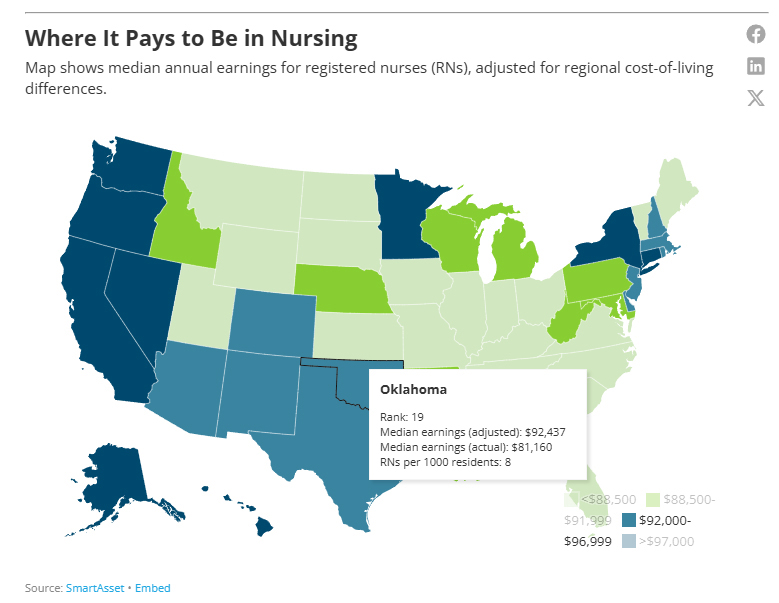
Nursing is a calling, but it’s also a paycheck, and location can have a major impact on that paycheck’s true value. While demand for nurses exists across the U.S., compensation does not factor evenly from state to state. After accounting for differences in local costs, some states offer nurses materially stronger earning power than others, making geography an important part of the profession’s financial equation.
SmartAsset evaluated the median earnings of registered nurses (RN), licensed practical nurses (LPN) and nurse practitioners (NP) in each of the 50 states, adjusting earnings for regional cost-of-living differences to compare places. We also examined earnings for nursing assistants.
Key Findings
Nursing has a Pacific premium. If you’re an RN within driving distance of the Pacific Ocean, chances are you’re among the profession’s top earners. Even after adjusting for the West Coast’s higher costs of living, Pacific states have the highest median earnings for nurses, led by California (No. 1), with Hawaii (No. 2), Oregon (No. 3), Alaska (No. 4) and Washington (No. 5) rounding out the top of the chart.
Nurse practitioners earn more in rural states. States with large rural areas top much of the list for nurse practitioner earnings, including New Mexico (No. 2), Iowa (No. 3), Oklahoma (No. 4) and Alaska (No. 6). According to the National Rural Health Association, demand for nurse practitioners in rural areas is high and “nearly half of all rural primary care practices employ at least one NP.”
Despite ranking last for RN pay, this state has the most nurses. South Dakota, No. 50 in the rankings, pays RNs less than any other state ($69,510; $78,454 price-adjusted). However, it also boasts the most RNs per capita — 16 for every 1,000 residents.
Nursing assistants are in a prime position in North Dakota. With adjusted median earnings of $49,652, nursing assistants earn more in North Dakota than any other state. The Roughrider State also employs the most nursing assistants per capita (nine per 1,000 residents).
Expert Insight
“Compensation must be treated as a strategic investment, not a cost to minimize. Nurses who feel valued stay. Competitive, transparent pay tied to retention bonuses, profit sharing and merit-based outcomes signals that loyalty and performance are rewarded — not expected.”
— Erin Slay, DNP, MHA, RN (Associate Dean, Central School of Practical Nursing)