
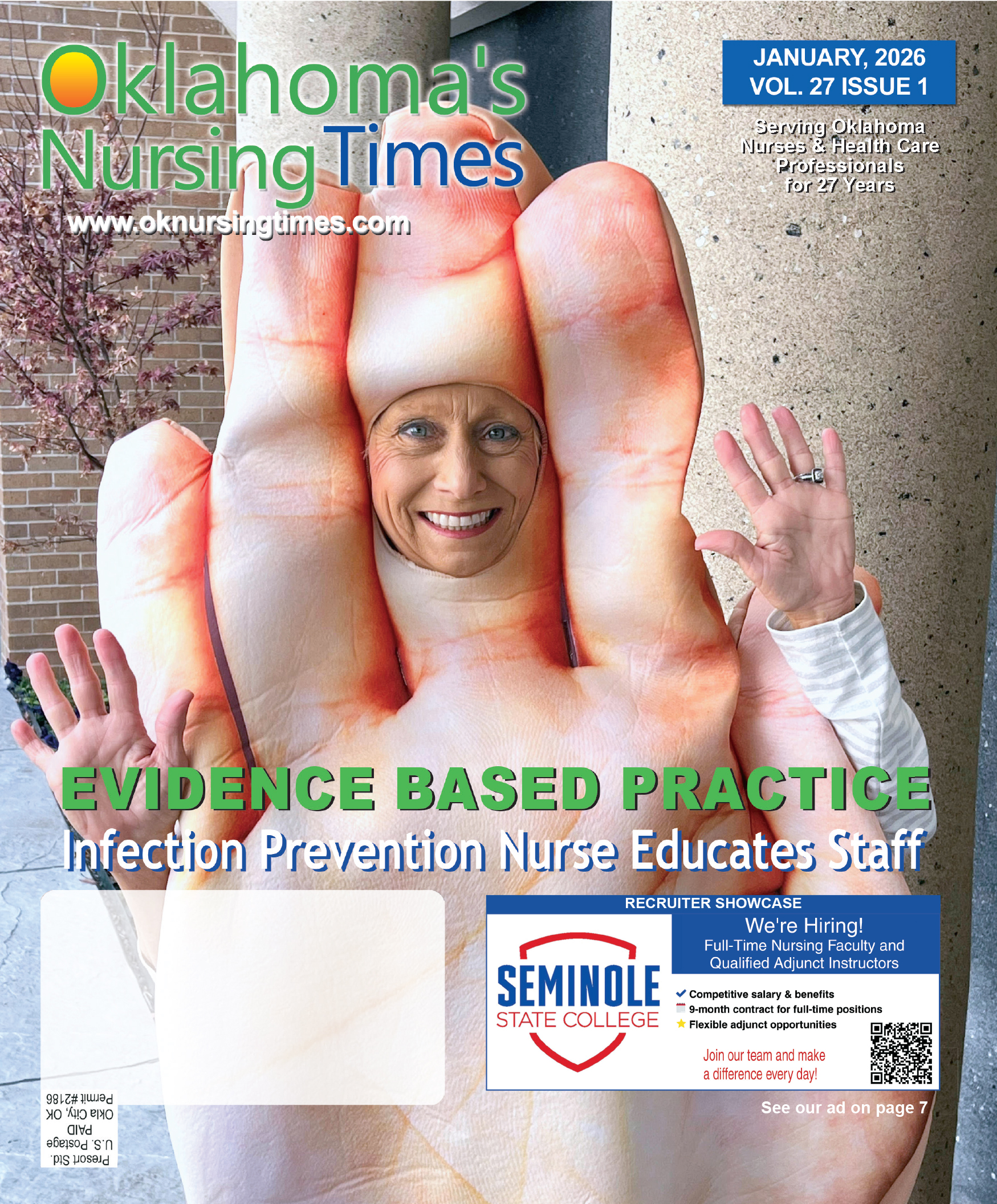

Infection prevention nurse educates staff
By James Coburn, staff writer
Debbie Dahl, RN, knows that viruses don’t take a holiday. And she’s dedicated her career to preventing them from infecting others. Nursing became the second career for Dahl, the infection prevention nurse at SSM Health St. Anthony Hospital Midwest.
“I really enjoy microbiology. I love germs — I love diseases — so it’s a great background,” Dahl said.
Dahl taught biology at Moore High School before becoming a nurse. Dahl earned her Bachelor of Science degree in Nursing at Kramer School of Nursing Oklahoma City University. She was in her 50s and the oldest student in her nursing class.
Dahl later earned her Master of Science degree in Nursing at Oklahoma Baptist University which was fully paid for by the State of Oklahoma.
“I saw a scholarship listed in Oklahoma’s Nursing Times. It said free scholarships and I applied for it out of the Nursing Times, and I got it. There’s always stuff in the Nursing Times people can find,” said Dahl, 68.
She’s been with SSM Health St. Anthony Hospital Midwest for nearly two years. It’s her second time at Midwest because the day she passed her NCLEX exam, she walked into the hospital and was hired as a med/surg nurse.
“Many of the nurses are still here that I worked with over 15 years ago,” she said. “I really felt like I was coming home. I loved coming back to SSM.”
She does not do hands-on nursing with patients. Her role as the infection prevention nurse brings her in contact with the hospital staff. Dahl never thought she would face an unprecedented event like the COVID pandemic. Many infectious disease nurses in the U.S. retired during the pandemic. But they made it through and since then nurses have taken a deep breath about lessons learned, Dahl continued.
It’s respiratory season in Oklahoma. There is a deadly, contagious fungus called Candida aureus spreading in the state, Dahl said. It spreads easily among patients and healthcare facilities, according to the Centers of Disease Control and Prevention. “It is a fungus. It can get into your blood, your urine and it is a 60 percent mortality rate,” Dahl said. “It is going around Oklahoma now. As of last Friday (December 26), I think Oklahoma had 178 cases already this year (2025).”
The fungus is not airborne but is contagious by touching by contact. There is no vaccination or treatment for it, Dahl said. So, the patient will live with the fungus all their life, Dahl said. People may not realize it, but tuberculosis still exists, however there is a treatment for it.
The prevalence of measles is on the rise in the U.S. It had surpassed 2,012 cases at the end of the year, according to the CDC. With 12 continuous months of measles, the U.S. is set to lose its elimination status.
“I wish people would take their vaccines, but it is a free country and you do not have to vaccinate your children, your loved ones. But it is highly contagious. It can stay in the air for 72 hours,” Dahl cautioned. “An outbreak of measles actually happened last summer here in Oklahoma. And the flu vaccines, those are always good to get.”
Virology is ever changing. What biomedical researchers know about the flu today and its treatment, is based on what virologists knew at the time.
“Next year they’ll say, ‘you did it wrong,’ but that’s how we learn from it all,” she said.
Flu vaccination always provides protection although not always 100 percent, Dahl explained. She talks with nurses and staff to keep them informed about what is happening in the facility and community around the state. People become worried when they read information in the news or social media. Dahl keeps things in perspective.
“We know we use the right chemicals. We use the right products that can stop the spread of diseases,” Dahl said.
She cited a great accomplishment at SSM Health St. Anthony Midwest. On December 26 at the time of this interview, there had not been a catheter induced urinary tract infection for more than 790 days. This means the nurses and physicians are upholding best practices in doing the right things.
“We try to take out your lines, so people are not getting an infection from the lines being there too long,” Dahl explained.
The hospital has been cited in several magazines for its low rate of surgical infections including MRSA, a type of staph bacteria that’s become resistant to many of the antibiotics used to treat ordinary staph infections.
“That means all of our staff are washing their hands, using the right precautions, and not spreading any diseases among the patients,” Dahl said.
When someone is in isolation, signs are placed alerting the staff to the type of isolation, whether they need to wear a gown, mask, face shield, or maybe an M-95 mask.
Dahl makes her husband wear the M-95 mask to fend off his allergies when mowing the lawn.
“They’re so tight. It does keep micro-particles from getting into your mucus membranes,” she said.
Not all masks are the same. The M-95 mask absolutely decreases the viral load that the person wearing it releases into the air, Dahl emphasized. So, it decreases the prospect of an infection to another person.