

RN Gives Her All to Save Lives
By James Coburn, staff writer
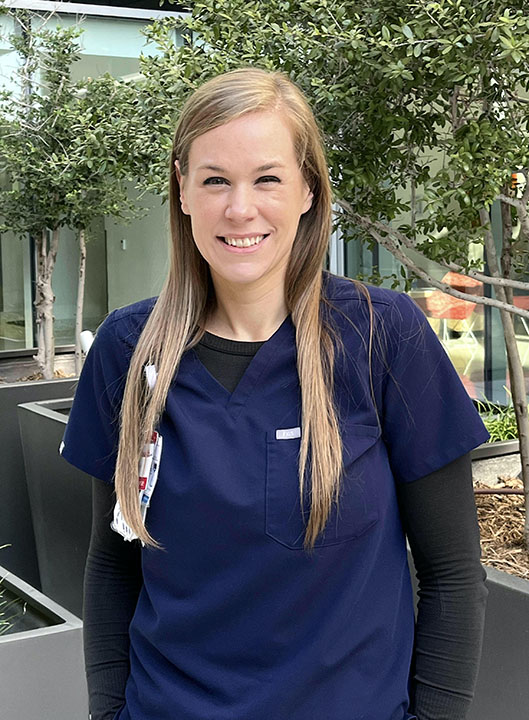
Megan Jordan, RN, has experienced many indelible moments as a trauma unit ICU charge nurse at OU Health University of Oklahoma Medical Center, located in Oklahoma City.
She recalled a patient she will never forget who passed away. The man was in a traumatic motorcycle crash resulting in a femur leg break. She picked up some overtime that week.
“I was with him throughout the whole process,” Jordan said. “And he especially will always have a piece of my heart because that one hurt really bad. And I will never forget him.”
His doctors, her manager, and the nursing staff consoled Jordan. They are always supportive of each other, she said.
“I always tell new nurses it’s okay to cry, it’s okay to feel your emotions. And then, you kind of just have to feel them and pick it back up, because we’re not here for ourselves. We’re here for our patients and their families,” Morgan said.
Jordan handles intense hours of stress by relying on her family and friends. She will play loud music on her way home and suggests having a cry when one is needed. She said her husband is extra caring when recognizing she has had a hard day. They have two children, ages 17 and 22.
“I hang out with my family. We went to Seattle and not too long ago we went to a concert. I feel that is great for nurses because it gives us a chance to kind of unwind, decompress, step away from the sadness for a while,” Jordan said.
OU Health University of Oklahoma Medical Center (OU Medical Center) is distinguished by being the first level-1 trauma center in the state. In July Ascension St. John Medical Center officially became Tulsa’s first and only level-1 trauma center by the American College of Surgeons. Level-1 trauma centers see injuries resulting from motor vehicle collisions, falls from 20 feet or more, stabbings, gunshot wounds, and other severe trauma.
“I like that adrenaline and I like helping people when they are at their most critical (condition),” Jordan said.
She said nursing students who aspire to work in a level-1 trauma center will need to have a lot of adrenaline, compassion, and the ability to stay calm in hectic and very stressful situations.
Jordan earned her Associate Nursing degree at Oklahoma City Community College. When working as an LPN at another hospital she earned her Bachelor of Science in Nursing degree at Southwestern Oklahoma State University and joined OU Medical Center in 2024 to work in the trauma ICU unit.
She was welcomed by a compassionate group of nurses who appreciate teamwork, she said. When time becomes hectic the team can rely on each other’s precise grasp of best practices. Some days are quieter as they help people through their healing process. But other days are busy with a plethora of level-1 admissions, going to CT-scans and having blood tests.
“During the most traumatic days of some people’s lives, I feel that we are very good at handling that emotion,” she continued.
It takes a lot of emotional intelligence to communicate with patients and families. Nurses develop coping methods when being with patients and families experiencing emotional turmoil. They also translate a lot of medical jargon for them.
“We just try to put ourselves in their shoes the best we can and try to at least empathize with them,” she explained. “We also offer them resources. We’ll get our chaplain involved. Our upper management is great in helping deal with those emotions.”
She needed a career that would sustain life giving care. She sensed the power of compassion as a child when a kind and personable nurse sparked her passion for nursing. The nurse helped Jordan when she was hospitalized with pneumonia for a week. After high school she worked in the insurance business before changing course at age 26.
There is an obvious need for more nurses in today’s world of a nationwide nursing shortage, Jordan said.
“Anybody that’s interested in something like that, then follow your dreams and go for it,” Jordan said.
The University of St. Augustine for Health Sciences reports that 1.2 million new registered nurses will be needed by 2030 to address the current nursing shortage in the United States.
Her career has influenced her view of the world around her. She’s very aware of her surroundings when driving a car. She cautions her children to be careful, wear a seatbelt, and to stay off their phones. She has seen the aftermath of car wrecks.
“Whenever we have patients that are going to donate their organs, that’s when we have an honor walk. That’s when family and friends, workers at the hospital all get to line the halls and honor that person after not only passing away, but them making the decision or their families making the decision to donate their organs,” she said.