


Rare procedure may spare children a lifetime of repeated open-heart surgeries
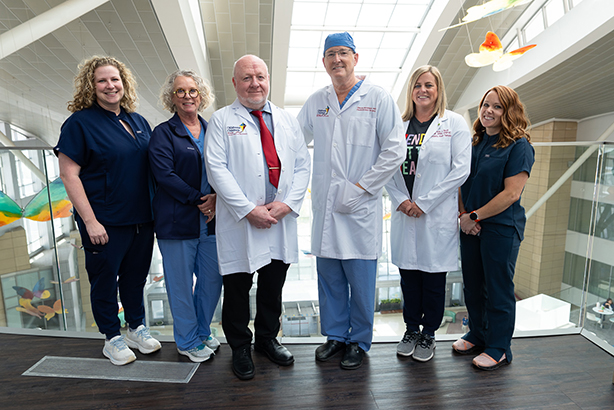
Oklahoma Children’s OU Health has performed Oklahoma’s first partial heart transplant, replacing an infant’s failing heart valves with living valves from a donor heart that can grow with the child.
The surgery, performed by the pediatric heart team at Oklahoma Children’s, is the first of its kind among both pediatric and adult transplant programs in the state. Fewer than 50 partial heart transplants have been performed in the United States, placing OU Health, the University of Oklahoma’s academic health system, among a highly select group of centers nationwide capable of performing this technique.
Valves That Grow With the Child
A partial heart transplant may be needed when a child is born with or develops severe heart valve disease that cannot be adequately repaired or replaced with traditional options. In these cases, standard valve replacements offer limited success because they do not grow with the child.
As a child grows, fixed-size valves can become too small or stop functioning properly, leading to complications and the need for multiple open-heart surgeries over time. A partial heart transplant offers an alternative by using living donor tissue that has the potential to grow with the patient.
“For a child born with a damaged heart valve, the hardest part has always been that a replacement valve does not grow with them,” said OU Health pediatric cardiothoracic surgeon Dr. Harold Burkhart, M.D., director of the Pediatric Cardiothoracic Surgical Program at Oklahoma Children’s and professor and chief of the Division of Cardiac, Thoracic and Vascular Surgery at the University of Oklahoma College of Medicine.
“That has meant returning to the operating room again and again over the years. A partial heart transplant changes that. We are placing living valves that grow with this child, and that can spare a family from a lifetime of repeated surgeries.”
As the name suggests, in a partial heart transplant, surgeons replace only the damaged heart valves using living tissue from a donor heart rather than replacing the entire organ.
A Gift Made Possible by Organ Donation
Every partial heart transplant begins with the gift of organ donation. The valves come from donor hearts that cannot be transplanted whole, allowing tissue that would otherwise go unused to help save lives. At a time when organ donation rates have declined, this approach underscores the difference a single donor can make.
“Only a small number of children in the country have received a partial heart transplant, and every case depends on a family’s decision to donate,” said OU Health pediatric cardiologist Dr. R. Erik Edens, M.D., Ph.D., medical director of pediatric Heart Failure and Transplant at Oklahoma Children’s and professor at the University of Oklahoma College of Medicine.
“These are hearts that could not be used for a full transplant. Being able to give those valves to a child who needs them is an extraordinary thing. We are proud to take part in a national effort to study this approach and to bring it to families in Oklahoma.”
Advancing the Science
Because no formal training exists for this procedure, the Oklahoma Children’s surgical team adapted techniques from complex pediatric heart surgeries to guide their approach. Edens is currently participating in a national study group collecting outcomes data on partial heart transplants, contributing to ongoing research, education, and clinical advancement.
The team is also exploring domino transplants, in which valves from a child receiving a full heart transplant may be used to help another child who only needs valve replacement, maximizing the impact of each donated heart.
“This is just the beginning for our program,” Burkhart said. “Children born with complex heart disease deserve every chance at a full life, and their families should be able to find that care here at home in Oklahoma.”
Looking ahead, the Oklahoma Children’s OU Health Presbyterian Health Foundation Heart Center — expected to open to patients in early 2030 — will centralize and expand pediatric cardiac care in Oklahoma, further supporting innovation like these emerging transplant approaches and strengthening care for patients with complex needs.
Learn more about the new Oklahoma Children’s OU Health Presbyterian Health Foundation Heart Center at OklahomaChildrens.org/HeartCenter.
-###-
Oklahoma Children’s OU Health
Oklahoma Children’s OU Health is anchored by the state’s only comprehensive, freestanding children’s hospital and powered by a statewide team of pediatric experts — delivering care through hospital-based services and pediatric clinics located across the Oklahoma City metro area, including the University of Oklahoma Health Campus and communities throughout the state. Proudly serving all 77 counties, we bring breakthroughs to every child and every family. With unshakable optimism and a family-centered approach, our pediatric specialists lead with empathy, innovation and unstoppable drive.
As part of the University of Oklahoma’s academic health system, OU Health, the pediatric specialists at Oklahoma Children’s are at the forefront of medical innovation, conducting groundbreaking research and training future healthcare leaders. Families trust our pediatric expertise, from leading-edge heart surgery to 24/7 emergency care.
We offer the state’s only pediatric Level I Trauma Center, the most comprehensive Level IV neonatal intensive care unit, the region’s sole pediatric heart transplant program, and a dedicated pediatric mental and behavioral health facility coming in 2026. At Oklahoma Children’s, we provide a family-centered approach to healing, supported by resources like pet therapy, music therapy, and child life specialists.
Discover more at OklahomaChildrens.org.