

An Oklahoma Medical Research Foundation scientist has received a two-year grant to explore one of biology’s oldest mysteries: how chromosomes find the correct partner before an egg or sperm cell is formed.
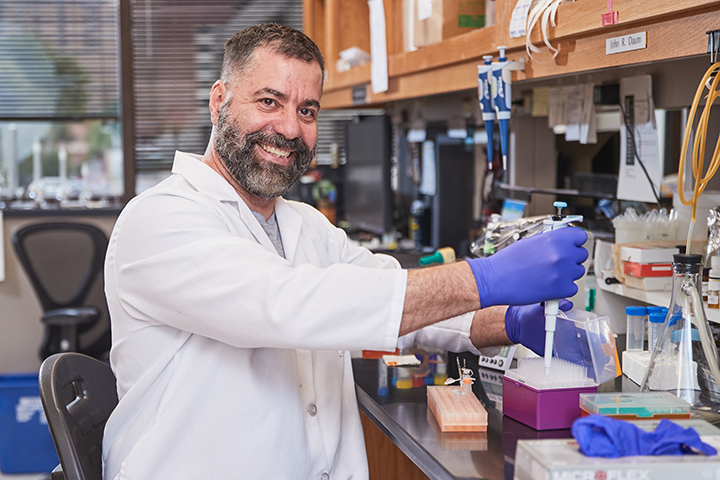
With a $470,000 grant from the National Institutes of Health, OMRF’s Roberto Pezza, Ph.D., will build on a new method he developed a way to observe chromosomes moving inside living cells in real time.
For more than a century, researchers have pieced together snapshots to understand this critical process. Pezza’s new imaging process allows scientists to watch the entire process unfold as it happens.
Every person inherits one copy of each chromosome from their mother and one from their father. Before eggs and sperm are created, these matching chromosomes must recognize one another and join together before separating correctly. If that process goes wrong, it can lead to miscarriages or genetic conditions such as Down syndrome.
Using his new imaging system, Pezza’s lab discovered a previously unknown way that chromosomes locate and join one another in male reproductive cells. The scientific journal Nature Communications recently published this discovery.
With the new grant, Pezza will now investigate the same process in female reproductive cells.
“Understanding exactly how healthy eggs and sperm are formed may help us develop better ways to predict or perhaps even prevent pregnancy loss,” Pezza said.
An estimated 20% of all pregnancies end in miscarriage, with most occurring during the first trimester. Ther risk for miscarriage and having a baby born with Down syndrome or other congenital disorders increases with the age of the mother.
“With more people choosing to have children later in life, understanding the fundamental biology behind chromosome behavior is more important than ever,” Pezza said.
Pezza’s grant, No. R21HD118636-01A1, was awarded by the Eunice Kennedy Shriver National Institute of Child Health & Human Development, part of the NIH. His lab’s recent discovery was supported by grant No. R01HD110990 from the same NIH institute and also by funding from the Presbyterian Health Foundation.
______________________________________________________
Ovaries remain active after menopause, OMRF scientist says
For decades, women’s health experts have operated under the assumption that ovaries become dormant after menopause. But recent studies suggest that’s simply not true, an Oklahoma Medical Research Foundation scientist says.
“Ovaries remain biologically active once their reproductive job is finished,” said Michael Stout, Ph.D., whose lab studies female reproductive aging. “They may continue to affect a woman’s health for the rest of her life.”
Stout and a longtime collaborator, Francesca Duncan, Ph.D., made their case in an article published this month in the prestigious journal Science. The article stemmed from a workshop held by the National Institute on Aging.
“The postmenopausal ovary has been referred to as a wrinkled and shriveled husk,” said Duncan, a professor at Northwestern University’s medical school. “Women commonly spend a third of their lives after menopause, and it is becoming increasingly clear that the ovary does not become defunct. We need more research, and we must change the language surrounding this organ to match modern scientific discoveries.”
Today, postmenopausal years comprise more of most women’s lives than ever before. According to the U.S. Centers for Disease Control and Prevention, American women who reached menopause in 1925 could expect to live another 20-25 years. Over the past century, science and improved health care have added a decade to that expected lifespan.
The implications of recent ovarian research aren’t clear, but Stout said discoveries increasingly link postmenopausal ovaries to inflammation, even in the absence of infection.
Therefore, he said, aging ovaries might become vehicles for inflammation to form and then travel to other parts of the body. This type of chronic, low-level inflammation has been linked to conditions including cardiovascular disease, neurodegeneration, muscle loss and metabolic disorders.
Stout has played a key role in developing scientists’ understanding of ovarian aging, helping to identify specific types of immune cells that change as ovaries age.
Recent studies have led some scientists to ask whether women should remove their ovaries after menopause to improve overall health. “We know that removing ovaries before menopause increases the risk of chronic disease,” Stout said, “but removing them after menopause has remained largely untested.”
So, that question – like many others in the field – remains an open one, Stout said. “There ’s so much more to learn about the postmenopausal ovary.”
___________________________________________________________
OMRF to hold estate planning seminars in OKC, Tulsa
The Oklahoma Medical Research Foundation will host estate planning seminars this fall for attorneys, CPAs, certified financial planners and trust officers.
The half-day seminars are anticipated to provide four hours of continuing legal education through the Oklahoma Bar Association and four hours of continuing education through the American Banking Association and the Certified Financial Planner Board of Standards. CPAs will self-report attendance.
Seminar dates and locations are:
Oklahoma City – 1-5 p.m. Nov. 12, Oklahoma City Golf & Country Club, 7000 NW Grand Blvd.
Tulsa – 8 a.m. to noon Nov. 13, The Summit Club, 15 W 6th St.
This year’s speaker is Christopher Hoyt, a law professor at the University of Missouri, Kansas City. Hoyt teaches courses in federal income taxation, charitable organizations and retirement plans.
Hoyt’s OMRF seminars will include these topics:
“Inherited IRA Rules Made Simple”
“Solving Trust Issues: Inherited IRAs Payable to Trusts”
“Getting Hitched Without the Hitches: Estate Planning for Retirement Assets in first and second Marriages”
“Giving Gets a Twist: Changed Tax Incentives for Charitable Gifts in 2026”
Argent Trust Oklahoma is the presenting sponsor for this event. Other sponsors are HoganTaylor, Bank of Oklahoma Private Wealth, BancFirst, MidFirst Private Wealth, Rogers & Bell, Busey Bank, Hartzog Conger Cason, and Trust Company Oklahoma.
Registration is $125. For more information or to register, visit omrf.org/seminar or call 405-271-7400.