

By Bobby Anderson, RN
Long a coveted path for advancement in nursing, opportunities for nurse anesthesiology education in our state have historically been limited.
But as advanced practiced nursing is more and more a driver in today’s health care delivery system, the demand has reached a critical juncture.
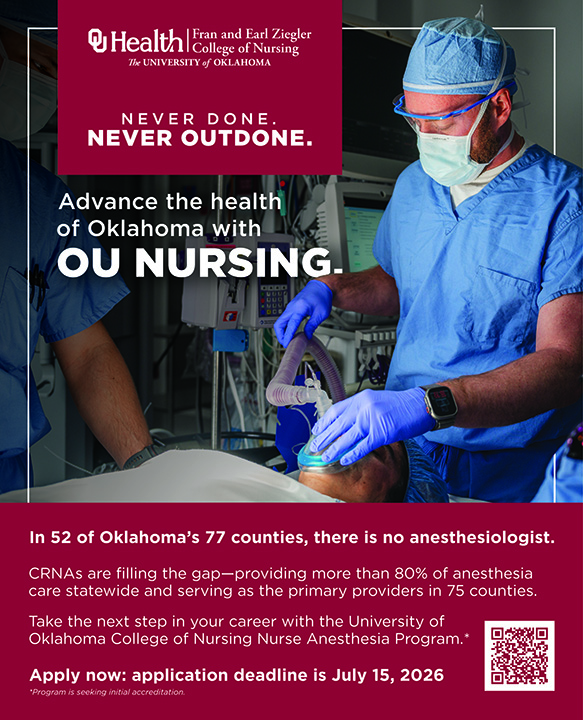
That’s why leaders at the Fran and Earl Ziegler College of Nursing at the University of Oklahoma are excited about the upcoming Doctor of Nursing Practice (DNP)–Nurse Anesthesia track.
“As the flagship College of Nursing in Oklahoma, it is our mission to meet the nursing workforce needs of the state with the urgency that it deserves. That mission is going to be substantially bolstered by this new DNP CRNA track. The support for this from the legislature, OU leadership, faculty and staff at OU College of Nursing, and clinical partners across the state, has been a joy to experience. This support is the reason we are so clear about the need, so proud to be able to offer this education, and why we are absolutely confident it will be an overwhelming success, said Dr. Melissa Craft, dean of the college.
Charged with beginning the first CRNA clinical pathway at OU is Angela Mund, DNP CRNA FAANA FAAN.
“There’s been so much excitement about this program,” she said. “I get non-stop emails from interested applicants, which is good.”
The university is in the process of obtaining initial accreditation from the Council on Accreditation of Nurse Anesthesia Educational Programs. Applications are open and the first class is expected to launch in January 2027, pending accreditation.
The application window closes July 15.
Mund expects several hundred applicants for the inaugural class.
Mund has been active in nurse anesthesiology for more than 20 years including serving as President of the Association of Veteran’s Affairs Nurse Anesthetists and the President of the South Carolina Association of Nurse Anesthetists. She was the 2022-2023 President of the AANA.
She is a proud veteran of the US Army Nurse Corps. In 2022, she was appointed by the Secretary of Veteran’s Affairs to serve on the Veterans Administration Rural Health Advisory Committee.
Mund said the healthcare needs that CRNAs are currently filling in our state is outstanding.
“I’ve never been so impressed by the clinical practice of CRNAs in Oklahoma compared with all the states I’ve been involved in,” she said.
The Doctor of Nursing Practice (DNP)–Nurse Anesthesia track is intentionally designed to prepare Certified Registered Nurse Anesthetists (CRNAs) for advanced clinical practice and leadership in complex healthcare environments.
It is a 36-month program resulting in a DNP degree.
The curriculum follows a deliberate progression, beginning with rigorous didactic coursework, advancing to high-fidelity simulation experiences, and culminating in immersive, longitudinal clinical education.
This structure ensures that students develop a strong foundation in advanced science and anesthesia principles prior to assuming increasing responsibility in patient care settings.
According to the Oklahoma Board of Nursing, 52 of Oklahoma’s 77 counties lack an anesthesiologist. At the same time, CRNAs represent more than 80% of anesthesia providers statewide and are the primary anesthesia professionals in 75 counties.
By creating this pathway, the College of Nursing is directly addressing the state’s need for advanced practice CRNAs, particularly in rural and underserved communities.
In Oklahoma, CRNAs play an indispensable role in ensuring access to surgical, obstetric, trauma, and pain management services across the state. They are the primary, and often only, anesthesia providers in many rural and critical access hospitals, enabling communities to maintain local surgical care rather than requiring patients to travel long distances for essential procedures.
CRNAs in Oklahoma practice at the top of their education and training, supporting high-acuity care in academic medical centers while also sustaining anesthesia services in smaller community facilities. Their impact is direct and measurable: improved access to care, continuity of services, and a resilient healthcare infrastructure that depends on CRNAs to meet the state’s diverse and growing healthcare needs.
The announcement of the new CRNA track last fall was a continuation of OU’s commitment to expand access to care and ensure alignment with workforce needs.
“These program enhancements reflect the innovation and adaptability that define our approach to preparing the next generation of nurses in Oklahoma,” said Gary Raskob, senior vice president and provost, University of Oklahoma Health Campus. “From accelerating degree completion to expanding advanced practice opportunities, we are committed to meeting Oklahoma’s workforce needs while upholding the highest standards of nursing education.”